
Share options are an attractive form of remuneration as a means of encouraging employees to commit to a company. These options confer the right to purchase shares in a company (“stock options”) or to subscribe for them following a capital increase (“warrants”) at a predetermined price within a specified period. This form of remuneration is also attractive from a tax perspective, but it can become more complex in the event of cross-border employment. After all, in cross-border cases it can lead to double (non-)taxation. Following our discussion of the tax systems in Belgium and the Netherlands, we are going to examine this in more detail here.
Share Options Under Belgian Tax Law
In Belgium, share options that the beneficiary expressly accepts within sixty days of them being granted are taxed under the Act of 26 March 1999 (hereinafter “qualifying options”).
If the underlying shares to which the qualifying options relate are listed on a stock exchange, the taxable benefit at the time these options are granted is determined on the basis of the average market price over the previous 30 days or the closing price on the day prior to the offer. If the shares are unlisted, the taxable benefit of these options is assessed on a flat-rate basis (18% of the value of the shares for which the options were granted). Furthermore, the flat-rate valuation can be halved if certain conditions are met. Non-qualifying options are taxed at the time of exercising at the value of the underlying shares.
The employer granting the options deducts withholding tax. These options are subject to the progressive rates of Belgian personal income tax or tax for non-residents (rates rising to a maximum of 50% by 2026); the withholding tax deducted is offset against this. No employer’s or employee’s social security contributions are payable on these options.
For both qualifying and non-qualifying options, no tax will be payable when the underlying shares are sold, provided that the sale forms part of the normal management of private assets. A bill is currently being drafted to introduce a capital gains tax on financial products (including options and shares), applicable to gains realised from 31 December 2025 onwards. This draft bill is unlikely to be voted on until sometime in 2026, but the intention is for it to come into force from 1 January 2026.
Share Options Under Dutch Tax Law
For the Dutch tax authorities, share options granted to employees are treated as remuneration. From 1 January 2023, tax is levied when the underlying shares become tradable, rather than when the options are exercised. The employee may, however, still opt for taxation upon exercising, but must notify the employer of this choice in good time. For listed companies, a maximum deferral period of five years applies.
At the time of taxation, the benefit derived from the share options is subject to payroll tax and income tax (Box 1) at a progressive rate of up to 49.50% (2026). The payroll tax deducted by the employer acts as a withholding tax. The benefit is equal to the market value at the time of taxation, less the (exercise) price paid. Depending on how the value of the share options develops, the choice of when to tax them will result in a higher or lower tax liability.
Once the shares have ceased to be classified as salary income, they are classified under Box 3, Box 2 or Box 1. At the moment, the actual income (dividends and capital gains) is not taxed in Box 3. However, tax must be paid annually on a notional return (2026: 6%). This levy has long been the subject of debate. A system based on actual returns is expected to come into effect as of 2028. Capital gains will then be taxed at 36% annually (i.e. taxation applies even without disposal). However, the new government has recently put forward plans under which this system may be subject to further changes, meaning that tax will only be levied when the gain is realised.
If an individual holds 5% or more of the shares in a company, or if they have a lucrative interest (“excessive remuneration”), a different tax system applies (Box 1 or Box 2). In both scenarios, the actual returns are taken into account. In these situations, the tax liability can be significantly higher (for a lucrative interest in 2026, up to 49.5% for Box 1; in Box 2, a lower rate of 24.5%/31% applies subject to certain conditions).
Overview of Taxation on Share Options in Both Countries
An employer grants its employee 1,000 options on 1 January 2026. Neither the options nor the underlying shares are listed on the stock exchange. The underlying shares are valued at €1 per share. The options have a 10-year exercise period and may be exercised no earlier than in the second year following the year in which they are granted. The underlying shares themselves may only be transferred in the fifth year following the year in which the options are granted.
The following timeline can be drawn up:
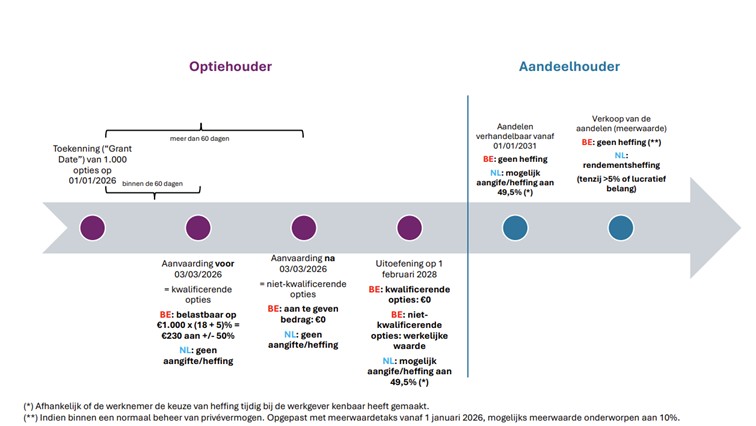
The example above shows that double taxation may occur in the following situations, amongst others:
- A Belgian resident is granted share options by a Belgian employer. He accepts these within 60 days (qualifying options) and subsequently moves to the Netherlands.
- A Dutch resident is granted share options by a Dutch employer. He accepts these options after more than 60 days and exercises them as soon as possible. He subsequently moves to Belgium.
Both the Belgian and the Dutch authorities have devised a (possible) solution to address this double taxation.
Cross-Border Employment Between Belgium and the Netherlands
In most countries, share options are taxed at the time of exercising. Differences in the time when tax is levied can lead to double taxation or non-taxation in cross-border cases. The Belgian and Dutch tax authorities have unilaterally drawn up guidelines to address this issue.
Preventing double (non-)taxation by Belgium
The Belgian tax authorities maintain that share options are deemed to relate to the professional activity being carried out at the time the options are granted, but this can be rebutted. It is therefore advisable, when offering share options to employees, to clarify the specific activities for which this benefit is granted.
If the employee is working in Belgium when the options are granted, Belgium has the right to tax these options. In the event of a salary split, the benefit is divided between Belgium and the Netherlands on a pro rata basis (in proportion to the time spent in each country), unless other criteria are put forward.
Where options are granted to Belgian residents, Belgium will apply its tax rules and tax qualifying options when they are granted, even if no business activities are carried out in Belgium. Since the Netherlands taxes the options at a later date (see above), there is not (yet) any question of “double taxation”. Belgium will only grant a (partial) tax refund if the income is actually taxed in the Netherlands. But the taxpayer has to take the initiative here. However, if the options are not exercised until much later (or not at all), it may no longer be possible to offset the Belgian tax.
To avoid this, the idea of granting non-qualifying share options could be considered, insofar as this is possible under the Dutch tax system. These are then taxed when they are exercised, both in Belgium and in the Netherlands. In that case, an exemption subject to progressive taxation will apply in Belgium.
Preventing double (non-)taxation by the Netherlands
In her decision of 22 November 2024, the Secretary of State published policy guidelines for cross-border situations.
In principle, all benefits received by Dutch residents are subject to Dutch payroll tax and/or income tax. Where applicable, double taxation is avoided via the tax return. This depends in particular on whether the benefit arises before or after the share options are exercised. It is therefore advisable to keep a close eye on this.
For non-residents, there is a risk of double (non-)taxation. This may be the case if the benefit is not treated as income for income tax purposes, even though payroll tax is payable. The Secretary of State has approved the suspension of payroll tax, subject to certain conditions. In any event, the benefits must not be linked to work carried out in the Netherlands.
The Implications of the New Double Taxation Agreement Between Belgium and the Netherlands
The new double taxation agreement between Belgium and the Netherlands, which will replace the existing 2001 agreement, was signed on 21 June 2023. It is not yet known when the treaty will actually come into force.
The current double taxation agreement provides for a so-called compensation scheme for cross-border workers. This means that Dutch residents who are taxed on their wages in Belgium can, under certain conditions, apply for a tax reduction in the Netherlands.
However, the new treaty excludes share options from this scheme if their value is taxed in Belgium in a calendar year other than the year in which the Netherlands taxes the remuneration linked to these options.
Conclusion
The issue of the potential double taxation of share options will persist under the new double taxation agreement. Moreover, expressly excluding share options from the compensation scheme where tax is levied in Belgium in a different year to the Netherlands means that greater reliance must be placed on the unilateral solution devised by the Member States themselves. So the taxpayer still has to take action themselves to resolve the issue of double taxation.
It is therefore advisable to take the above issues into account when drawing up share option schemes. Furthermore, it may be worth considering whether it would be more advantageous to receive non-qualifying options. In complex cases, it may also be worth thinking about seeking legal certainty through a ruling.